Why Strength Training Is the Best Non-Hormonal Support for Perimenopause

Perimenopause can feel like the body has changed the rules without warning. Sleep becomes lighter. Joints feel stiffer. Weight sits differently. Muscle tone fades faster than it used to. Even people who eat well and walk often can feel as if their usual habits no longer work.
One major reason is the shift in oestrogen. As oestrogen levels fluctuate and decline, the body becomes more vulnerable to muscle loss, bone loss, insulin resistance, joint discomfort, and mood changes. Strength training is so useful because it pushes back on those exact changes.
It is not a magic fix, and it does not replace medical care. Hormone therapy, nutrition, sleep support, pelvic health care, and mental health support all have a place. This article is general information only, not personal medical advice. But as a non-hormonal strategy, lifting weights offers something unique: it applies mechanical load to muscle, bone, tendons, and the nervous system. That load tells the body to keep building and repairing.

Perimenopause changes the body’s maintenance system
Perimenopause is the transition before menopause, when ovarian hormone production becomes less predictable. It can last for several years. During this time, oestrogen may rise and fall sharply before eventually declining.
Oestrogen does more than regulate periods. It affects many tissues, including:
Muscle
Bone
Tendons and ligaments
Brain chemistry
Blood vessels
Fat storage
Insulin sensitivity
Sleep regulation
When oestrogen drops, the body may lose muscle more easily. Bone remodelling can also shift in the wrong direction, with more breakdown than rebuilding. At the same time, many people notice more abdominal fat, slower recovery, and a lower tolerance for stress.
This is why “eat less and do more cardio” often fails during perimenopause. A smaller diet may reduce scale weight for a while, but it can also reduce lean muscle if protein and resistance training are missing. More cardio may improve heart health, but it does not provide enough direct loading to preserve muscle and bone.
Strength training gives the body a different message: this tissue is needed, keep it.
Mechanical load is the reason lifting works
The body adapts to what it is asked to do. If muscles do not face resistance, they have little reason to stay strong. If bones do not face load, they have less reason to stay dense.
Strength training uses resistance to create controlled stress. That stress is not damage in the harmful sense. It is a signal. Muscles respond by repairing and growing stronger. Bones respond by increasing or maintaining density in the areas that carry load. Tendons and connective tissue adapt more slowly, but they also become more resilient over time.
This is the key difference between strength work and general movement.
Walking is excellent. Swimming can be kind to sore joints. Cycling can support fitness. But these activities do not load the skeleton in the same way as a squat, deadlift, loaded carry, step-up, or overhead press.
For bone and muscle, the body needs enough challenge to notice.
That does not mean extreme training. It means progressive training. A five-kilogram dumbbell may be enough at first. Later, the body may need eight kilograms, then 10 kilograms, then a barbell, machine, or heavier kettlebell. The principle is simple: when the body gets stronger, the training should slowly grow with it.
Muscle is metabolic protection
Muscle is not just for shape or strength. It is active tissue that helps regulate blood sugar, energy use, and metabolic health.
During and after perimenopause, insulin sensitivity can change. This means the body may have a harder time moving glucose from the bloodstream into cells. Strength training helps because working muscle uses glucose and stores it as glycogen. More muscle also gives the body a larger storage site for that glucose.
This can support steadier energy, fewer cravings, and better long-term metabolic health.
Diet still matters. Protein, fibre, calcium-rich foods, and enough total energy all support the process. But dieting without strength training can create a problem. Weight loss may come from both fat and muscle. In midlife, losing muscle is costly. It can lower resting energy use, reduce strength, and make future weight management harder.
A better goal is body recomposition, not just weight loss. That means:
Keeping or building lean muscle
Reducing excess body fat if needed
Improving strength and function
Supporting blood sugar control
Protecting bone and joint health
The scale may move slowly, or not much at all. But clothes, posture, stamina, and everyday strength often change in ways the scale cannot show.
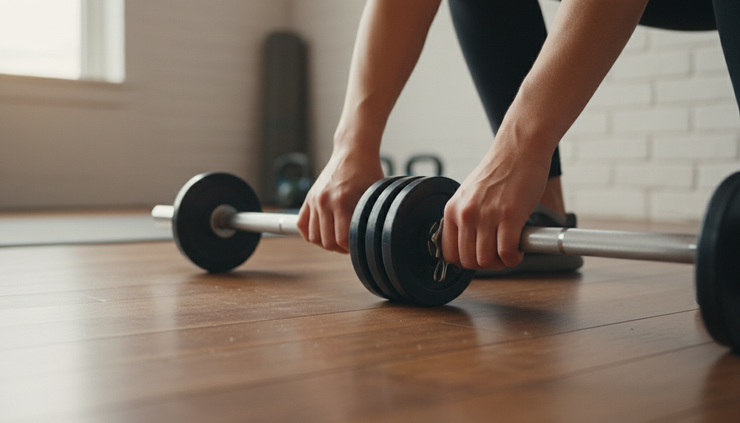
Strong bones need more than calcium
Bone health often becomes a concern after menopause, but the groundwork starts earlier. The hormonal changes of perimenopause can speed up bone loss, especially when strength training, impact, protein, vitamin D, and calcium are lacking.
Calcium is useful, but it is only part of the picture. Bones also need load. Think of bones as living tissue, not fixed structures. They constantly remodel in response to the demands placed on them.
Weight-bearing strength exercises are one of the clearest ways to place healthy demand on bones.
Good options include:
Squats
Lunges
Step-ups
Deadlifts
Hip thrusts
Farmer’s carries
Push-ups
Rows
Overhead presses
These movements load the hips, spine, legs, arms, and shoulders in different ways. That variety matters because bone adapts locally. A strong lower body exercise helps the lower body most. Upper body loading still matters for wrists, arms, shoulders, and posture.
For some people, higher-impact work such as small jumps or skipping may also help bone health. But impact should be matched to the person. Anyone with osteoporosis, a fracture history, pelvic floor symptoms, or significant joint pain should get individual advice before adding impact.
Strength training is adjustable. That is one of its biggest strengths. Machines, dumbbells, resistance bands, kettlebells, barbells, and bodyweight exercises can all work when they are used with the right level of challenge.
Joint pain often improves when muscles do their job
Many people become more aware of joint aches in perimenopause. Knees complain on stairs. Hips feel tight after sitting. Shoulders get cranky. Hands and feet may feel stiff in the morning.
Oestrogen changes can affect inflammation, collagen, tendon health, and pain sensitivity. But weak muscles can make the problem worse. When muscles around a joint are undertrained, the joint may absorb more stress than it should.
Strength training helps by improving how force moves through the body. Strong glutes support the hips and knees. Strong back muscles support the spine and shoulders. Strong calves and feet help with balance and walking. A stronger core helps transfer force without overloading the lower back.
The key is smart loading. Pain does not mean “push through no matter what”. It means choose the right version of the movement.
For example:
If squats hurt
If lunges hurt
If push-ups hurt wrists
If deadlifts feel awkward
Try box squats, leg press, or supported sit-to-stands
Try step-ups, split squats with support, or reverse lunges
Try incline push-ups on a bench or dumbbell handles
Try kettlebell deadlifts from a raised surface
A good strength program should leave joints feeling worked, not wrecked. Some muscle soreness is normal when starting. Sharp pain, swelling, or pain that worsens over time needs professional help.
Mood and sleep benefit from the nervous system effect
Perimenopause mood changes are real. Anxiety, irritability, low mood, and poor sleep can appear even in people who have never struggled with them before.
Strength training can support mental health through several pathways. It can reduce stress reactivity, improve confidence, support sleep pressure, and create a steady rhythm in the week. Research also links resistance training with improvements in symptoms of anxiety and depression for many adults.
Part of the benefit may come from the nervous system. Lifting requires attention. It asks the brain to coordinate breath, balance, tension, and movement. A focused set of Romanian deadlifts or rows can pull attention away from rumination and back into the body.
There is also a confidence effect. Perimenopause can make the body feel unreliable. Strength training rebuilds trust. Picking up a heavier weight, climbing stairs more easily, or carrying groceries without strain sends a clear message: the body is still capable.
That mental shift matters.

Cardio and dieting are not enough on their own
Cardio is still valuable. It supports heart health, blood pressure, endurance, and mood. Walking, cycling, swimming, dancing, and hiking all belong in a healthy midlife routine.
The problem starts when cardio becomes the only tool.
Long cardio sessions without strength training may not protect muscle. In some cases, especially with under-eating, they can add fatigue without solving the underlying loss of lean tissue. Dieting alone has a similar problem. It can shrink the body without making it stronger.
Strength training fills the gap because it targets the tissues most affected by hormonal change.
A balanced weekly routine might include:
Strength training two to four times per week
Walking or other low-intensity movement most days
One or two cardio sessions if recovery is good
Mobility work where it helps
Rest days without guilt
The best mix depends on fitness, symptoms, injury history, sleep, and available time. But if perimenopause has made the body feel softer, weaker, stiffer, or less metabolically steady, strength training deserves priority.
What an effective perimenopause strength plan looks like
A useful program does not need to be complicated. It needs consistency, progression, and enough recovery.
Most people do well with full-body strength training two or three times per week. Each session can include five basic movement patterns.
Squat or knee-dominant movement
Examples include goblet squats, box squats, split squats, step-ups, or leg press.
These train the thighs, glutes, hips, and trunk. They also load the hips and legs, which matters for future mobility.
Hinge or hip-dominant movement
Examples include Romanian deadlifts, kettlebell deadlifts, hip thrusts, and cable pull-throughs.
These build the glutes, hamstrings, back, and posterior chain. They are especially useful for posture, hip strength, and lifting objects safely.
Push movement
Examples include incline push-ups, chest press, shoulder press, and landmine press.
These strengthen the chest, shoulders, triceps, and upper body bones.
Pull movement
Examples include seated rows, one-arm dumbbell rows, lat pulldowns, and band rows.
Pulling exercises support posture, shoulder health, and upper back strength, especially for people who sit a lot or carry tension in the neck.
Carry or core movement
Examples include farmer’s carries, suitcase carries, dead bugs, side planks, and Pallof presses.
These train the trunk to resist movement and transfer force. That is more useful than endless crunches for many people.
How hard should the weights feel?
The weight should feel challenging but controlled. A simple guide is to finish most sets with one to three good repetitions left in reserve. That means the set is hard enough to create change, but not so hard that technique falls apart.
For general strength, many exercises work well in the range of 6 to 12 repetitions. Higher reps can also work, especially for beginners or joint-sensitive movements, as long as the muscles are challenged.
Progress can look like:
Lifting a heavier weight
Doing more repetitions with the same weight
Improving range of motion
Moving with better control
Needing less rest for the same work
Feeling stronger in daily life
The body does not need punishment. It needs a clear signal, repeated often enough to adapt.
Recovery becomes part of the training
Perimenopause can make recovery less predictable. Poor sleep, hot flushes, stress, and heavy periods can all affect performance. A smart strength plan allows for this without quitting.
On high-energy days, lift heavier or do more sets. On low-energy days, keep the habit but reduce the load. Two lighter sets are better than skipping for weeks because the plan feels too hard.
Recovery basics matter more than fancy extras:
Eat enough protein across the day
Include calcium-rich foods unless medically restricted
Get safe sun exposure or check vitamin D if needed
Sleep as well as symptoms allow
Take rest days
Avoid crash dieting
Build gradually after illness or injury
For anyone with pelvic floor symptoms, prolapse, osteoporosis, uncontrolled blood pressure, significant pain, or a history of cancer treatment, it is wise to get guidance from a qualified health professional or exercise physiologist.

The real goal is strength for the next decade
Perimenopause is not a short pause before life returns to normal. It is a transition into a new hormonal stage. The habits built here can shape health for decades.
Strength training stands out because it directly addresses the changes that matter most: muscle loss, bone loss, metabolic shifts, joint stress, and mood instability. Cardio and nutrition still matter, but lifting gives the body a signal they cannot fully replace.
Start simple. Choose a few basic movements. Train two or three times per week. Add weight gradually. Notice how daily life changes.
The goal is not to chase soreness or train like an athlete. The goal is to build a body that can carry groceries, climb stairs, protect bones, steady blood sugar, and feel capable through perimenopause and beyond.


Comments